
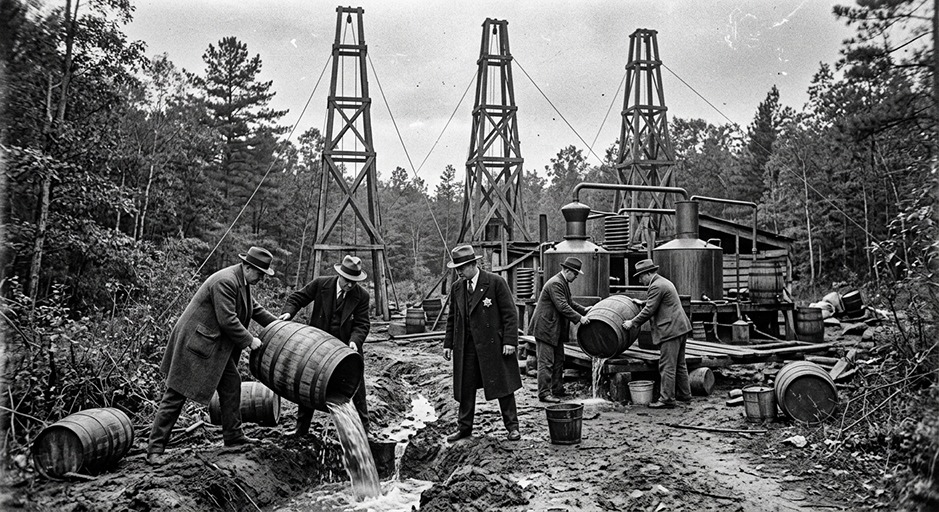
Sixty miles northeast of St. Louis, in the small immigrant coal town of Benld, Illinois, four real mines dotted the landscape — No. 1, No. 2, No. 3, and No. 4. Then there was a fifth, standing about a mile east of town in a wooded gully near Cahokia Creek. Locals called it “Mine No. 5,” and it never produced a lump of coal in its life. Its tipple-shaped exterior was a disguise for a bootleg distillery capable of turning out around 2,000 gallons of liquor a day — roughly half a million gallons a year — that dominated the black-market booze trade across Madison, Montgomery, Sangamon, and Macoupin counties. Illinoisgenweb
Benld was fertile ground for this kind of operation. Founded in 1904 as a coal town with a large immigrant population, it had grown to some 3,300 residents and at least 32 saloons by the start of Prohibition, earning a reputation as a lawless “frontier town.” The still’s builders knew how to hide in plain sight: they positioned it near the creek for its water supply and dressed it up to look exactly like the town’s other coal-mining infrastructure. Jacksonville Journal-CourierIllinoisgenweb
The operation’s underworld pedigree is where fact slides into legend. Local lore has long attributed the still to Al Capone’s crime syndicate, and old-timers swear they saw the man himself around town. One Benld native, interviewed at age 95 in 2012, insisted Capone visited repeatedly and personally arranged for the liquor to be shipped north to Chicago. But the claim doesn’t hold up well under scrutiny: a prominent historian of Illinois Prohibition-era gangsters has said he’s never found anything placing Capone in Benld, noting that Capone’s known downstate visits were duck-hunting trips, while the region south of Peoria was firmly Shelton gang territory, not Capone’s. Whoever actually ran it, the operation was real, industrial-scale, and audacious — and it reportedly ran with a wink from local authorities. By some accounts, county and state police knew exactly what Mine No. 5 was and simply looked the other way. Illinoisgenweb + 3
The good times ended in 1928, when federal agents — who answered to no local arrangement — raided and shut the still down, ending a run in which it was capable of producing as much as 100,000 gallons of moonshine. It was a small entry in a much larger federal campaign: nationally, Prohibition agents seized 11,416 stills and 15,700 distilleries in just the one-year stretch from mid-1928 to mid-1929 alone. SubstackThe Mob Museum
As for what happened to Mine No. 5’s copper stills, tanks, and tunnels after the raid — unlike, say, a seized fleet of cars or a stash of contraband liquor, which the government sometimes auctioned off — there’s no clear surviving public record of a formal federal sale. Prohibition-era equipment seizures were typically dismantled or destroyed outright rather than resold, and Mine No. 5 appears to have met that fate: rather than change hands at auction, it simply became a ruin. Traces of the site are still visible today near Cahokia Creek. Illinoisgenweb
The legend proved more durable than the liquor. Nearly a century later, a retired Illinois State Police officer opened a winery in Benld and named it, with evident relish, No. 5 Mine — a bootlegger’s ghost turned into a tasting room, in a town that decided its “colorful” past was worth remembering after all.
Compiled and sourced by Claude AI