
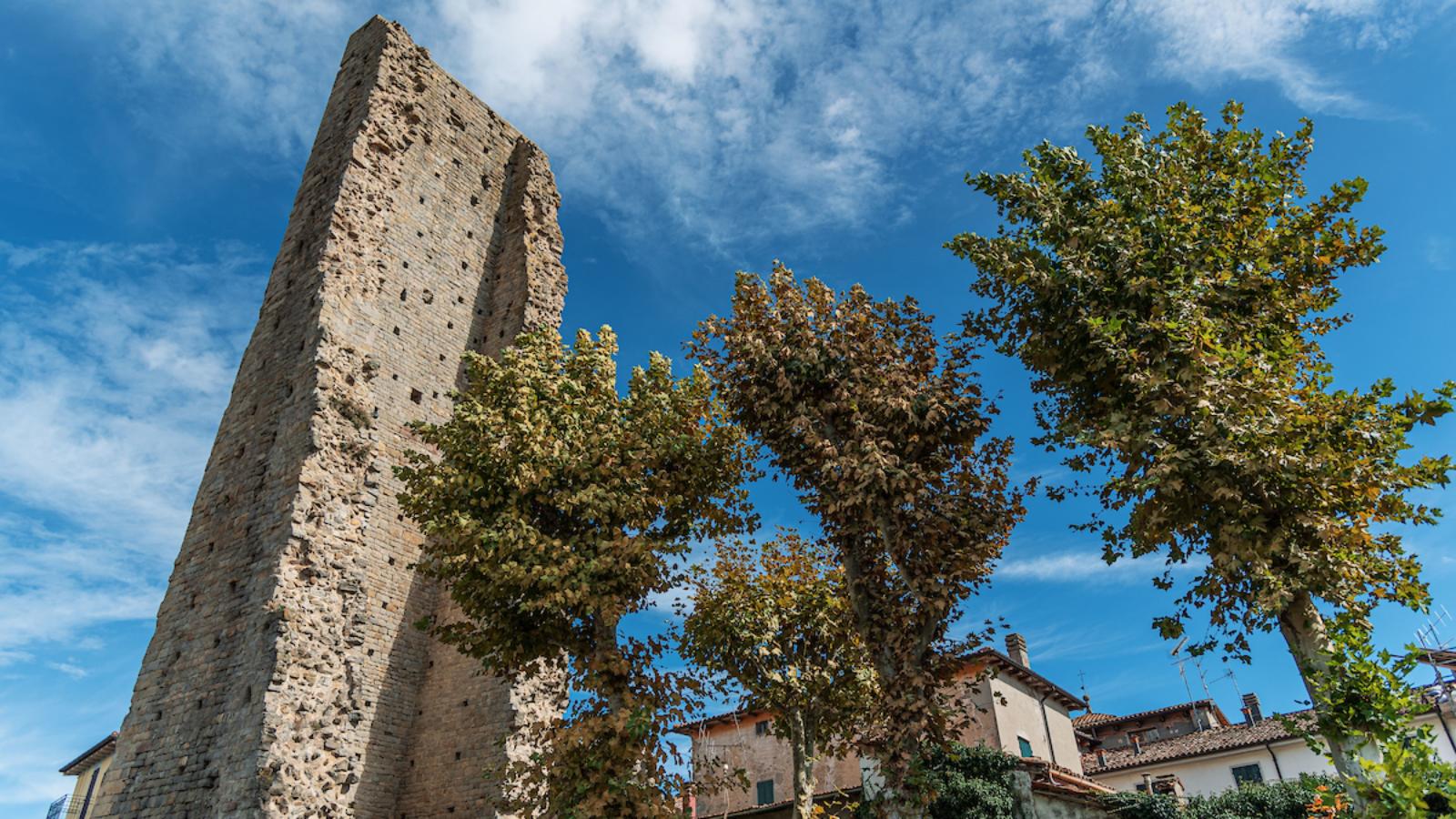
Castel di Casio is our Italian home, the birthplace of our paternal grandfather. It’s story and its history date back to the Roman Empire.
Castel di Casio rises at 533 meters in the Bolognese Apennines, tucked into the Limentra Valley between Lake Suviana and the Reno River, about 60 km southwest of Bologna. Its name traces back to Roman times, derived from Vìcus Cassi(“hamlet of Casio”) — a prosperous Roman-era settlement confirmed by 1836 excavations that unearthed funerary urns, some containing gold coins.
A Medieval Crossroads
In the Middle Ages, Casio belonged to the powerful Countess Matilde di Canossa before passing to the Alberti counts of Prato. In 1219, after a grueling six-month siege, it fell under the control of Bologna, which fortified the open village into a proper castle-town and made it the seat of the Podesteria and the Capitanato della Montagna (Captaincy of the Mountain) — the most powerful administrative post in the Bolognese highlands, a role it held until the 15th–16th century. Sitting on the contested ridge road between Bologna, Pistoia, and Florence, the village saw its share of battles before eventually joining the Papal States in the 16th century.
The Tower and Wall in the Piazza
The village’s proudest landmark stands right in its central square: the ruins of the Torre di Casio, a sandstone tower built in 1219 by Comacine stonemasons, once reaching roughly 30 meters and crowned with battlements. Earthquakes — notably in 1470 and again in 1846 — took their toll, cracking the tower vertically and lowering its height, but its broken silhouette still dominates the valley skyline. Alongside it, fragments of the old perimeter wall remain visible — built under the guidance of Gislimerio da Casio as a boundary line following a peace accord with Pistoia, and later reshaped after a 1337 siege by Visconti troops redefined the town’s compact medieval layout around that same piazza.
Population, Then and Now
Today Castel di Casio is home to roughly 3,300–3,400 year-round residents (official ISTAT figures put it at 3,361 as of early 2025), spread across the main village and its many small frazioni like Badi, Suviana, and Casola. That’s a steep drop from its 19th-century peak, when the chestnut and charcoal trades supported a population north of 6,000 before 20th-century emigration toward Bologna and northern Italy’s industrial cities thinned the hills. There’s no official separate summer count, but as a recognized mountain resort (luogo di villeggiatura) near Lake Suviana’s beaches and watersports, the village visibly fills out each summer with returning families, second-home owners, and hikers drawn to its mild climate and trails.
What It’s Known For
Castel di Casio belongs to Italy’s national “Città del Tartufo” (Truffle Towns) association, and its Tartufesta truffle festival is a local highlight, alongside an atmospheric August medieval reenactment with costumed processions and games. Traditional Apennine fare — crescentine, zampanelle, and the yeast-free flatbread crescenta from the hamlet of Lizzo, baked between clay molds — rounds out its culinary identity. Add the nearby Perìo spring, Romanesque Oratory of Sant’Ilario, and Lake Suviana just beyond town, and Castel di Casio offers a compact but rich slice of Apennine history and mountain life.
Compiled by Claude AI